Showing posts with label Housing. Show all posts

Wednesday, April 15, 2009

Formaldehyde revisited

Much has been written about the 'Toxic Trailers" and other stuff. I've written about the issue before and although that post is one of my top hit getters (whatever that means) there have been no comments. FEMA has never suggested to us that our trailer should be tested.


Last fall FEMA was talking us about moving and I asked if we could get ours tested. They said sure, someone will call you and set something up. I wasn't hopeful. FEMA never returns phone calls. I was surprised when they called a couple of days later. We set a date to meet and test the trailer. That was October 28, 2008.

On January 2, 2009 FEMA taped a note to the trailer door, we were on vacation. After we got back we traded phone calls because the person who contacted us said that he needed to meet with us in person to deliver the report. Unfortunately he was out of Baton Rouge was only occasionally in New Orleans and couldn't predict when he would be back. After a couple of tries, he stopped returning calls. He probably was transferred.


A couple of weeks ago I started trying to get a copy of the report. Our New FEMA Person (the only one we've talked to more than once) called. She had the numbers, and more amazingly gave them to me over the phone.

On October 28, 2008 our trailer tested at 63 parts per billion (63 ppb).

She is going to send me a report as soon as she can find it. I'm beginning to think she might.

For perspective I'd like to offer this OSHA regulation;
Permissible Exposure Limit (PEL) -

*1910.1048(c)(1)*

Time-Weighted Average (TWA): The employer shall assure that no employee is exposed to an airborne concentration of formaldehyde which exceeds 0.75 parts formaldehyde per million parts of air (0.75 ppm) as an 8-hour TWA.

*1910.1048(c)(2)*

Short Term Exposure Limit (STEL): The employer shall assure that no employee is exposed to an airborne concentration of formaldehyde which exceeds two parts formaldehyde per million parts of air (2 ppm) as a 15-minute STEL.

According to EPA

Levels in Homes

Average concentrations in older homes without UFFI (Urea-formaldehyde foam insulation) are generally well below 0.1 (ppm). In homes with significant amounts of new pressed wood products, levels can be greater than 0.3 ppm.

Looks like we off gassed down to "normal" levels.

California through the California Air Resources Board has adopted standards that apply to lumber products only, not finished structures. Unfortunately other materials may contribute to Formaldehyde levels in a structure including foam insulation, fabric and carpet, to name a few.

EPA is also proposing some controls although they seem to be following California's lead, and regulating products not finished structures.

Monday, February 23, 2009

Fixing the Mortgage Mess

I'm not very optimistic about fixing the mortgage mess. It looks like no one has any really good ideas and the politicians are not willing to accept the reality than the pre-bust housing market was artificially created by easy credit, speculation and a whole transaction fee industry willing to pass the problem on to the next guy. For the foreseeable future the housing market will be smaller, slower and more conservative.

Early experience with private workouts is not very encouraging. It appears a large number of people who get workouts soon fall behind again and eventually end up in foreclosure anyway. Not long ago the president of a local bank was on the radio expressing his concern that five states are causing most of the problem and that even there traditional fixed rate mortgages were very stable.

Republicans seem stuck on the "Moral Hazard". It also seems to be the basis of most of the opposition. No one wants bad or reckless actors to benefit from their own reckless actions.

Democrats seem stuck on giving something to anyone to save everyone. If you want to give me some money to help my neighbor, I'm ready to take it.

I have a suggestion (actually two).

First, instead of offering to simply "keep people in their homes" by letting someone else pay for part of their house, how about offering to sell people in trouble a house, but require they buy a house they can actually afford. The government then has a house it can sell to someone else, possibly at a loss but at least there will be activity in the market and no one gets something for nothing.

As an alternate, I suggest establishing government insured shared equity mortgages, and converting as many loans as practical to this type of loan. This way the government has a method of recouping at least some of our money they spend by capturing it when the house is sold in better times. The potential appreciation of the underlying asset will allow the government to eventually sell the mortgage to recoup at least some of our money sooner.

In both of these instances you avoid a large part of the Moral Hazard because the people getting help have given up something of value for that help without wrecking their lives. Hopefully learning something in the process.

Saturday, July 19, 2008

The FED Declares War on the Self Employeed

I have been following the "Housing Crisis", which as far as I can tell was largely triggered by lenders willing to lend money to anyone with a pulse for a transaction fee. Aided and abetted by the residential Real Estate industry and some political interest groups and politicians under a variety of excuses to expand home ownership.


The recent announcement by the FED to require "proof of income" is a major change and impediment to free markets. In effect the only "proof of income" will become a "proof of tax".

Taxes will set you free.

I am a victim of previous policies which discriminated against the self-employed. Prior standards implied that unless you had a "steady job", (which could end at any moment) you were a credit risk, regardless of your FICO score, your history of paying off loans or cash in your business, regardless of how long your business had been in operation (in my case more than 20 years). The whole process was/is stupid and offensive.

I wonder why employees of mine who have a year or less of tenure are able to get mortgages much easier than I can. It seems perfectly clear to me that if my business goes south, I am the last man standing. It also seems obvious that my history as a self-employed person is less important than anyoneelse's W-2.

Sunday, February 24, 2008

Whose Mortgage Crisis is it?

"Activists" are blaming the big bad bankers;
"The people who bought here thought they were living the American dream, but they could never afford the loans they were given," said Livia Villareal, counseling services director at the Greater Southwest Development Corp., a local non-profit."
I seem to recall a few years ago these same "activists" (or their cousins) were calling on lenders to make credit available to non-traditional borrowers. People who had been locked out of home ownership due to "economic" discrimination and "red-lining".

In 2003 during American Homeownership Month George W. Bush proclaimed,
Although a record number of Americans own their own homes, we continue to see a gap between the homeowner-ship rates of minorities and nonminorities. By a significant margin, minority families are less likely to own their own homes. Therefore, I have called upon the entire housing industry to join with my Administration to expand minority homeownership across the Nation. Our goal is to help at least 5.5 million minority families become homeowners by the end of this decade, and our Blueprint for the American Dream Partnership is taking bold steps to make this a reality.
The Current Home mortgage "crisis" was predictable and inevitable. I turned down a mortgage that was "too good to be true', because the eventual escalation of the payment was unsustainable.

Just to prove it's not a Republican Plot, here's a statement from Bill Clinton's White House Aug 1, 2000
Incentives for home ownership

There is no more crucial building block for a strong community and a promising future than a solid home.“ The Clinton Administration is dedicated to making the dream of homeownership a reality for all Americans. In 1995, the Administration, in partnership with 50 key public and private sector organizations, formed a National Homeownership Strategy with the goal of helping more Americans become homeowners.

Accomplishments include:
  • Lowering Interest Rates by Paying Off the National Debt.
  • Record Levels of Homeownership Assistance via 1.3 million loans from the Federal Housing Administration.
  • Helping Renters Buy Their First Home via homeownership vouchers for 50,000 families.
  • Providing Incentives to Save for a Home via Individual Development Accounts, providing incentives through federal matching funds for low-income families to save for a first home, higher education, or to start a new business.
None of the official sources mention the pressure put on lenders to offer credit to "non-traditional" borrowers, or to eliminate "red lining". Both of which could be easily taken as code words for reducing underwriting requirements.

These were not the primary means the mortgage market was subverted. The primary driver was the acquiescence of Ginnie Mae and Freddie Mac indicating to the markets that writing new risky types of mortgages was backed by the US Government. The Lenders, insulated from the risk of default and benefiting from the transaction fees, forged ahead.

In effect risk and reward became disconnected.

There were ways to increase homeownership by offering less risky, nontraditional mortgages, like shared equity mortgages or other suggestions put forward by Bernard Condon of Forbes Magazine.

We seem to have discarded the lessons of the past for the allure of something for nothing. Many of the people who are now in dire straits bought too much house for their income by any traditional standard. This artificial demand caused the housing bubble, artificially high housing prices and rampant speculation.

The borrowers are not entirely to blame, in many ways they are victims. They had many helpers. The Real Estate Industry chasing ever bigger commissions, the Loan Origination Industry chasing transaction fees and the equities markets looking at short term gains over long term stability. Still if something is too good to be true, it usually is.

The difference between the lenders and the borrowers, is the borrowers were not as well equipped to evaluate the risk as the lenders. But the lenders had a backstop, Fannie Mae, Gennie Mae, the VHA and the VA who were all willing to let the train roll on in the name of increasing homeownership, however transitory. Everyone hoped that the reckoning they all knew was coming would happen to the next guy.

Tuesday, February 19, 2008

Riddle me this!

I've been looking at this map Maitri made and these FEMA maps.

Jim Carrey as the Riddler

In my neighborhood existing grade elevations are between three and six feet above sea level. We are required to build at least three feet above grade, resulting in a minimum floor elevation of six feet.

Immediately across the street in Gentilly the grade elevation is generally negative one foot and lower. They are required to build 3 feet above grade or one half food below sea level, whichever is higher. That makes the floor elevation a maximum of two feet.

In Lakeview the average grade elevations are negative three to six feet. There people are required to build three feet above grade or two and one half feet below sea level. That results in a floor elevation of negative two and one half feet.

There is no significant difference in the potential flooding from any of the most likely mechanisms for catastrophic flooding, breach of the levees or over topping (which would likely lead to breaches if it were substantial enough).

Frank Gorshin as the Riddler

Does this makes sense?

I wonder who thinks up this stuff?

I realize I have generalized the conditions to illustrate the principle.

Monday, February 18, 2008

Valued Policy

One reason insurers are dropping wind and hale coverage is to avoid inadvertently being held liable for losses from other specifically excluded perils.

This all stems for a statute called the "Valued Policy" statute.

The Mierzwa decision
The Court held that the Florida Valued Policy statute required the insurer to pay the full value of the building as long as any covered peril contributed to the total loss; the covered peril did not need to be the sole cause of the total loss.

The Mierzwa decision was subsequently overruled by an amendment to the Florida Valued Policy law. However, the statutory amendment will not preclude insureds in Louisiana and Mississippi from arguing that a similar interpretation should be applied to the Valued Policy statutes in those states.

Apparently one court has done just that.

It seems the Insurance Companies have several alternatives. They can stop writing policies. They can eliminate wind coverage. They could require flood insurance as a condition of writing new policies.

Most it seem have opted for eliminating wind coverage, although many stopped writing policies altogether.

The state should probably change the law and go to a proportional coverage. Of course that won't eliminate the problem of houses completely destroyed where no evidence of the cause exists.

Sunday, January 27, 2008

Residential Architecture

Recently Scout Prime posted a link to The Journal of American History special issue on Through the Eye of Katrina. Everything in it is interesting but one of the articles, New Orleans Architecture: Building Renewal especially caught my eye.

The article points out our collective ambivalence to anything built since about 1900. It mentions Cabrini Church. It doesn't mention the loss of the Rivergate nor the prospects of 2400 Canal, a fine example of SOM mid-century modern, which will likely be demolished instead of being adapted to a new use. The Ogden Museum has noticed the and is sponsoring a discussion "At Risk: 20th-Century New Orleans Urban Design and Architecture" February 7 3-5 PM. The museum has previously sponsored exhibitions ReBuilding New Orleans and New Orleans 2oth Century Architecture.

Since Katrina a large number of architects have devoted a lot of talent to developing new housing ideas incorporating the social context and realities of modern life. These ideas have only been built in a few places. One house if being built on the Gulf Coast, Bard Pitt is proposing to build some in his project and Tulane students have built one. Other than that people seem to be content to reproduce the past, poorly.

I am not an architectural historian, nor a New Orleans historian. I am a practicing Architect and long time resident of New Orleans.

New Orleans best architecture has to me, always been the architecture of the people.

The French Quarter is largely French/Spanish colonial forms. Similar to buildings is found throughout the Caribbean and Latin America. The Old Town of San Juan Puerto Rico looks remarkably like New Orleans except for the hills.

The antebellum wood frame Greek Revival houses in the Lower Garden District are local responses, not really seen much anywhere else, except perhaps Charleston, South Carolina where climate and economics were similar..

Creole Cottages, the Katrina Cottages of their day are citified versions of the country homes of small Acadian farmers. Shotguns in single, double and camel back varieties, where the low cost modular housing of the day, designed primarily to achieve the highest density possible. They primarily housed the working class including the waves of post Civil War immigrants.

Even the dominant commercial structures of the CBD often incorporate mass produced elements, such as standardized granite or case iron storefronts.

As New Orleans' economy wound down in the second half of the twentieth century and as outside influence increased building became more individualized and less distinctive.

The last interesting vernacular I can identify is what I call the New Orleans Gentilly bungalow. These houses were usually either built by or for Italian families moving up the economic ladder. They are usually characterized by a buff brick, similar to Italian brick. They often include arches and columns, often serpentine. The interiors frequently incorporated similar architectural features, often ornamental plaster with faux marble finishes.

The last major building wave in seventies and later, when much of the East was built, is generally undistinguished with most of the building imitative of either local historic styles, other historic styles or imitations of contemporary commercial buildings. Little of value was produced.

We are now in the in the greatest building wave since the post war building boom. This wave will set the tone for future construction for years, perhaps decades to come. Unfortunately the initial results are not good. Habitat for Humanity is one of the most prolific builders and they are building to the least common denominator. The other major influence seems to be the modular builders who also seem to be building derivative designs, based on teh preconceptions of the shelter press and the real estate industry.

I have great respect for any Architect who can build a practice on single family houses. I have enormous respect for Architects who can build a practice on relatively modest single family houses. Unfortunately the economic reality is that a single modest house can rarely be both innovative and economically practical for the Architects perspective. It simply takes too much time to develop, document and oversee the constructions of unfamiliar concepts, forms or materials.

There is a apocryphal quote attributed to several well known architects that goes,
Q: What would you do if you had a million dollars?

A: Practice Architecture until it was gone.
I have a friend who is a business consultant to architects. Several years ago he told me that a certain well known Starchitect will only accept a residential commission if the Owner agrees;
  1. The fee will be 22%
  2. The Architect will select and the Owner will purchase all of the furniture.
  3. The Owner should anticipate a construction cost of $700.00 per square foot, but no limit is imposed by contract.
If you do the math that works out to a fee of $152.00 per square foot. It's probably much more now.

Wednesday, December 26, 2007

What if we built a Project ...

... and nobody came?

Or A brief History of Public Housing, from My Perspective.

In the Beginning.


Public Housing didn't really start until the New Deal and was at least partly to provide work for out of work Architects, Engineers and construction tradesmen.

Here is a pretty good overview of the social policy aspects of New Deal housing.

Like most things in our society, the idea had many constituents for many reasons.

Some people saw public housing a better replacement for the substandard tenements in big cities. A wholesome place for low income workers to live.

Some people expected that as those families worked and raised their children that, true to the American ideal, the family or at least the children would move up and on to better lives.

Sometimes things are said for the benefit of one constituency, which aren't exactly false, but not exactly true either.

I don't think anyone back then expected Public Housing to become a separate society or that generations of families would live there.

The Second Wave

In the Fifties the government, flush with income from "temporary" war taxes, looked around and started a number of major programs like the Interstate Highway System and Urban renewal, (called Slum Clearance in earlier, less rhetorically evolved times). One of the major components of these programs were new Housing Projects, often built to new and largely untested theories of design.

The social impact of these developments was not well understood, nor was the impact of changes in our society brought about by WWII and continuing after the war. It soon became apparent that all was not well. New housing models were desperately needed for what came to be called the "Urban Crisis".

Later Developments

Scattered Site.

Scattered Site housing started in the mid sixties as an alternate to the concentration of the poor, vulnerable and dysfunctional in traditional projects, which was becoming apparent by then. As far as I can tell they continued into the 70's, and probably into the 80's. I think Johnson's War on Poverty was his idea of carrying the social ideas of the New Deal farther

The idea was that by integrating public housing into healthy neighborhoods the stigma of public housing/assistance could be reduced and the neighborhoods would be able to better absorb and deal with the dysfunctional elements.

It turned out Housing Authorities were not good neighbors plus they suffered from institutional issues dealing with their tenants. There were a lot of problems with maintaining the units.

Sections 8.


In the 70's the effort shifted to Section 8 projects where landlords essentially built projects and collected rent from HUD. The problem here is that tenants have few options and are still trapped. The landlords interest is to minimize the cost of operation in stead of maintenance, so there is an adversarial relationship between tenants, landlord and the Housing Authority. This was largely a reaction to the bureaucratic inertia and high cost of the established housing agencies. Really it was just privatizing the projects. I always though it ironic or prophetic that the military slang for a mental discharge was Section 8.

Vouchers.

In the mid 90's voucher programs began. They are still rent support, but are more directly connected to the tenants. There is still a problem in that HUD has a lot of qualifications for the landlords and many landlords are leery of getting involved. Too many subsidized tenants can lead to problems and there is little social support for the tenants. I'm not too familiar with these programs, although I favor a rent subsidy which had fewer landlord qualifications and attached more responsibility to tenants to find their own housing, essentially "mainstreaming" them.

Mixed Income Developments

This lead in turn to Mixed Income Developments were, for a variety of incentives, commercial developers agree to include a certain number of subsidized tenants in the development. The hope is that with market rate subsidies and a limited but guaranteed number of potentially problematic tenants, landlords will have an incentive to maintain their property in order to attract the market rate tenants needed for their projects to financially successful.

If you read my posts around the blogosphere, some of this will seem familiar. It's also from memory so it might not be right.

Sunday, December 23, 2007

Housing Policy - Redux

I'm stunned, over the last couple of weeks the most visible issue is Housing Policy. I've been writing about this for almost a year.

Here We Go Again.

[Re]Building Communities

Housing the Poor

The Public Housing Problem

None of these posts garnered much reaction, virtually none from the "activists". Mostly the comments were from people I know. I realize I'm not significant in the debate, except for my vote. But I wonder why the issue only came to a boil recently.

I'm not alone in this. I wonder why?

Friday, December 14, 2007

The Other Housing Crisis

Road Home Sell Outs

One of the options for the Road Home is to sell the State your house for 60% of the pre-K value, although if my appraisal from them is any indication it will be more like 40% of the real pre-K value. I've long wondered what would happen to those houses.


Recently the LRA said they expect to have 7,000 properties in New Orleans. Many of those will simply be bulldozed because they are too far gone. Most people with repairable houses seem to have been able to get more quicker from speculators or flippers. One factor may have been that Road Home was putting a floor on the market. That floor might collapse as Road Home winds down.

LRA has accepted New Orleans' Plan for those properties. Under the plan New Orleans
... expects its New Orleans Redevelopment Authority to receive 7,000 Road Home properties in the next year. The city's plan calls for the properties to be sold to developers or cleared for parks and community gardens in the next 10 years
I haven't been able to discern exactly how NORA is going to go about this. In the past they have offered blighted properties for redevelopment, but that process was slow, expensive, complex and convoluted. The results were frequently disappointing. The NORA Submission to the LRA has four methods of distribution identified.
  1. Lot Next Door program and transfers to individuals
  2. Transfers to for-profits and non-profits for development as residential property
  3. Utilization of properties as sites for community gardens, urban agriculture and pocket parks
  4. Selected use of properties for other uses expounded in neighborhood plans, such as community health centers, smallgrocers, and expansion of school and other facilities.
Blighted Properties

According their plan NORA also expects to get about 7,000 additional blighted properties. The city recently auctioned almost 2,000 tax delinquent properties and is expected to get more early next year. The sale was accomplished online and was apparently a great success. Hopefully NORA will employ a similar open process. I'd suggest getting eBay to do it.

Foreclosures

In addition Real Estate industry spokesmen expect as many as 20.000 foreclosures in New Orleans. That's a lot of houses to be disposed of and I don't see any lending institution wanting any part of the flooded ones with with repairs, maintenance and remediation costs, plus potential liability for concealed damage and mold, among other things. Most of these may eventually end up with the Feds, and from there go to NORA, but that is was pure speculation. NORA is already negotiating for FHA foreclosures.

Swapping.

Included in the Lot Next Door is a suggestion that NORA might engage in land swaps to improve clustering. That seems reasonable, but potentially subject to favoritism.

The Lot Next Door.

The Lot Next Door programs seems exclusively directed to Homeowners. It would allow Homeowners to acquire adjacent property on preferential terms. I see no reason it shouldn't, under a somewhat different conditions, also be directed toward landlords. It seems to me many rental properties could benefit from additional adjacent land for amenities and/or off street parking, which would enhance the value of the existing properties.

Where are the Families?

In reading the proposal I see no mention of individual families being given any direct assistance as new home owners. Only for-profit and non-profit developers are mentioned. That is a serious omission. I can imagine an opportunity for young families committed to New Orleans to invest sweat equity in a new or upgraded home. Most of us know people who using their own resources have completed restoration largely on their own. I can imagine community resources being used to assist people with skills training and other assistance.

Urban Homesteading.

I'd like to see an Urban homesteading program where infill properties in developing areas would be offered to potential home owners on favorable terms, in return for a covenant that the family complete renovations in a reasonable time and reside in the home for a reasonable time. Something similar to the Road Home covenants. Perhaps banks could be lined up to provide bridge financing for the renovations and guarantee a mortgage on completion for qualified families. Perhaps certain necessary professions could be offered even more favorable terms like teachers, police, firefighters and nurses. Perhaps military veterans, National Guard members, musicians or others might be attractive targets.

I understand that a modest 1200 sq. ft. Gentilly Bungalow can be rehabilitated for around $70,000, using "builder" quality materials and labor. With sweat equity this could probably be cut in half. Many people have now lived in FEMA trailers for two years now. I wonder if some kind of temporary on-site housing could be arranged for homesteaders while repairs are underway, possibly re-purposing existing surplus FEMA housing.

The Impact.

If these figures are correct, and I don't think any of them are really reliable, there may be as many as 35,000 houses that will be transfered to NORA. That's almost 10 times the number of public housing units being torn down.

Thursday, December 13, 2007

Here We Go Again; Another one from the vault.

G-Bitch posted this A Quote and Not-So-Random Ranting. She deftly points out a major problem with Public Housing in New Orleans. U.S. District Judge Peter Beer said,
"The central tragedy here is that their callous and indifferent 'leadership' was not unlike that which stalked our city generally after Hurricane Katrina," Beer wrote. "That same, self-serving, uncaring, 'pass the buck' bureaucratic swampland followed the examples set by city, state and federal officials."
He also pointed to inside dealing for the benefit of the few.
Beer issued a two-page opinion that blasted River Garden, saying that for more than a year after Katrina it leased units meant for St. Thomas residents to HANO management employees at rates designed only for low- or no-income occupants.
I've publicly advocated housing vouchers or subsidies paid directly to the tenants. All current programs I'm aware of involve paying either private landlords or public agencies to accept poor people. In these programs there is no incentive to provide service to the tenants. The road to higher profits is through lower costs, not more tenants.

Based on a very simple analysis it cost HANO $850 per month per unit for each unit authorized in 2004, and many authorized units were not occupied. The cost per occupied unit could not be easily determined. Since Public funding differs from private funding the costs could be either significantly more or less depending on how the cost of capital is calculated.

If subsidized tenants were given a market rate voucher, they would have an incentive to find the best hosing available. Landlords would have an incentive to compete with quality housing since the tenants could move if they elected to. The city would benefit by integrating communities.

There is a side benefit that many current housing programs concentrate not only the poor but the defenseless and poorly socialized into a few designated areas. This concentrates the most vulnerable together with the least socialized families most likely to create asocial individuals. It also segregates these people from from healthy families and communities, which some may see as a benefit.

The final and primary reason for market rate vouchers is that, if they had been authorized two and a half years ago, landlords and flippers would have used that to obtain private financing for renovations and repairs. There would have been an identifiable, profitable market for new units.

Instead we now have people sitting on the sidelines waiting for Blakeley to bestow the benefits of his largess.

Tuesday, August 15, 2006

Hiatus

She and I took an excursion last weekend. From noon Friday until Sunday afternoon I was completely out of electronic communication, even broadcast communication. I'm only now catching up with the rest of you.

One thing happened, in my sloth Tim wrote about trailer life and rain far better than I could ever have.

Go read it for yourself Rain and rainbows.

I'm very jealous. I wish I had his email address so I could thank him properly.

Saturday, July 29, 2006

The 50% Solution

I am astounded at the misinformation being spread about insurance and rebuilding.

New Orleans will be rebuilt one house at a time. What matters is whether a house can be rebuilt, economically and then insured. While I might not be 100% correct I think I have a pretty good handle on the rules.

This all hinges on the concept of "Substantially Damaged", as determined by the City of New Orleans. Under the Federal Flood Insurance Program rules, and the new state building code "Substantially Damaged" means damage equal to more than 50% of the pre-loss value of the structure, as determined by the City of New Orleans. The City of New Orleans has made a damage assessment for virtually all single family residences in the city.

Most of the damage is from flooding and was for the most part a limited kind of flood damage. The damage was simply an inundation by slowly rising and slowly receding flood waters. In spite of lot of scare stories these waters generally caused little structural damage. In a few cases structures near the breaches suffered damage due to rapidly flowing water, but that was relatively rare, even near the 17th Street Canal breach. My observation is that raised houses are more susceptible to that kind of damage because they were not anchored to their foundations as well as slab on grade houses.

The most common other types of damages are a limited amount of roof damage or damage due to falling trees. Many houses had little or no wind damage. The wind damage was greatly aggravated by the "chicken little" response of government at all levels which tended to present the most dramatic, most pessimistic interpretation of events. Had people been able to get back and take action sooner much of the actual loss could have been mitigated. Just opening the doors and windows in houses and throwing out the furniture as soon as possible would have helped a lot.

The City assessments are interesting. Virtually all flooded two story homes are assessed at less that 50% damage and are eligible to rebuild immediately and qualify for flood insurance as pre-existing structures. Virtually all single story homes which were only flooded and not otherwise damaged were assessed at just over 50%. In effect this gives the Owner a choice. They can appeal the assessment or they can accept it and apply for the additional benefits available for mitigation.

Here is the actual FEMA recommendation which has not yet been adopted in New Orleans (Although it has been adopted in Jefferson Parish).

FEMA recommends the following: new construction and substantially damaged homes and businesses within a designated FEMA floodplain should be elevated to either the Base Flood Elevation (BFE) shown on the current effective Flood Insurance Rate Map (FIRM) or at least 3 feet above the highest adjacent existing ground elevation at the building site, whichever is higher;
A typical Damage Assessment is recreated below.

Damage Assessment

Estimated Flood Depth:Unavailable
Flood Duration (days):Unavailable
Damage Report:52.13%

Report Detail:


Items

% Breakdown

% Damage

Superstructure (Framing/Masonry)

18.5

0

Foundations/Basements

16.9

0

Interior Finish (Plaster/Drywall)

8.7

100

Plumbing

8.0

50

Exterior Finish

6.2

20

Electrical

5.4

100

Cabinets/Countertops

5.2

100

Floor Covering

4.5

100

Heating-Cooling

4.2

100

Doors/Windows/Shutters

4.1

100

Lumber Finished

4.1

100

Roofing

3.9

10

Painting

3.4

100

Insulation & Weather Stripping

3.2

100

Built-in Appliances

2.5

100

Hardware

1.2

100


A typical house should be able to get this reduced. If for example, as many houses in Gentilly or Lakeview have, there was terrazzo flooring which needs only be cleaned and polished (bathroom tile floors can also usually be saved), or if the windows are operable, as are virtually all aluminum windows, even wood windows handled properly can be saved.

If you take those two items and reduce them to 50% damaged you have reduced the overall damage percentage by 4.75% to 48.95% and you can now obtain a permit to rebuild.

If someone were to decide that certain areas of the City cannot be rebuilt or should not be rebuilt the question of who will compensate the existing Owners of the existing property will become central. The result is likely to be massive long term litigation which would stall any progress.

Since I am stating an opinion that might have significant concequences if anyone should read and act on it I think it is necessary to caution everyone that each situation is different and each case must be evaluated on is merits.

Wednesday, July 19, 2006

Tin Can Classics

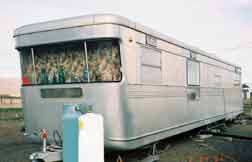
A couple of years ago I was driving around (actually I was the passenger) in Atlanta and we passed a startling sight. There was an old travel trailer with natural aluminum sides and a wraparound glass "windshield" rolling down the road. I had the driver shadow this unusual sight for several miles. On closer inspection it was clear this baby needed a lot of work but the lines below the surface were wonderful. From what little we could see the interior, through the windows at 70 miles an hour, was pretty worn and needed refurbishment but it was also clear the interior was built more like a classic boat that a house. That encounter sparked a frenzy of Internet searching which turned up a number of interesting things.


Not surprisingly there are several companies and groups around who specialize in the early (mostly post-war) travel trailers.


One group the "Tin Can Tourists" contributed to the name of this blog. They describe themselves in this quote from their website.
The Road to Enlightenment

The Tin Can Tourists were organized at Desoto Park, Tampa, Florida, in 1919. They received the official state charter a year later. The groups stated objective was "to unite fraternally all autocampers". Their guiding principles were clean camps, friendliness among campers, decent behavior and to secure plenty of clean, wholesome entertainment for those in camp. The group known for the soldered tin can on their radiator caps grew rapidly during the twenties and thirties. Members could be inducted fellow campers through an initiation process that taught the prospective member the secret handshake, sign, and password. After singing the official song "The More We Get Together" the trailerite was an official member of the Tin Can Tourists of the World.

Nearly everyone is familiar with the aluminum cigar shaped Airstream trailers, which are still manufactured. One of my neighbors has one in his yard. I think he had it Before and was using it until his FEMA model was delivered. Its still there as a sort of annex. It looks nothing like the one I saw in Atlanta. I was never able to confirm exactly what I saw that day but I was able to find similar one. It seem likely that the trailer I saw was a Spartan.

(All Spartan Trailers depicted were listed for sale on the Internet at the time of publication.)