Showing posts with label FEMA. Show all posts

Monday, September 26, 2011

Does anyone beleive this SHIT?

The latest dysfunctional Government fight over FEMA was resolved because;
FEMA spokeswoman Rachel Racusen, said the agency had $114 million left in its disaster relief fund, enough to last until Thursday or Friday, the final business day of the current budget year. She said the exact timing would depend on the number of emergency victims who apply for aid, and whether any new disasters occur.
I think FEMA loses or denies more applications in a week than $114,000,000 and if they could write a check for anything between now and Friday I'd drop dead from surprise.

I applied for aid once it took the six months to deny me.

Friday, May 14, 2010

I'd rather be in a FEMA trailer in New Orleans than in a penthouse anywhere else

I found the title quote by Gralen Banks;

"I'd rather be in a FEMA trailer in New Orleans than in a penthouse anywhere else,"

in this NPR story I hadn't seen before (or forgot about) reading another NPR Story about Treme.

Echoes of Lafcadio Hearn;

"Times are not good here. The city is crumbling into ashes. It has been buried under taxes and frauds and maladministraions so that it has become a study for archaeologists...but it is better to live here in sackcloth and ashes than to own the whole state of Ohio."
Odd that we now have a couple of from NOLA Blogger expats in Ohio.

Monday, April 19, 2010

The Trailer Two Step

Here we go again. There are still 350 trailers in New Orleans. I am not surprised you can see them scattered in neighborhoods all over the city. A few months ago I was in an unusual (for me) part of town and was surprised to see one. A shortly after that The Times-Picayune ran a story on the few trailers left in Jefferson.

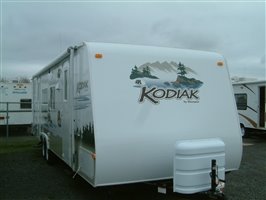
I started this blog to chronicle my life in a FEMA trailer and as self therapy for the dislocation after the flood. I had one of the first trailers. I was lucky because I had power and water at my house, many people didn't. I lived in it for over 2 years.

I had monthly inspections I had to take off from work to meet the FEMA inspector. The trailer gnomes came and did stuff when you weren't around (mostly adding new warning stickers).

I sat through a formaldehyde test, which turned out not to be that bad, although I never was actually warned about formaldehyde. It took months of calling to get the report and I never did actually get the full report, only a summary letter.

There was a tremendous trailer industry. There were installation contracts, electrical contracts, maintenance contracts, inspection contracts. Virtually none of the people involved in these activities was local. I don't think that in the entire time I was in the trailer a single person who came out was local. The same person never came twice. It was a revolving door of government employees and contractors.

In all that time no one ever offered to help me get out of the trailer (except into the rental assistance program). No one offered to help with the road home applications. No one offered to help create a housing plan. No one offered any rebuilding assistance. No one offered help finding contractors. No one offered to coordinate volunteers. No one offered to help me find government programs I was qualified for. No one even left me a brochure in government speak of options I could pursue.

I live in a mostly white, affluent neighborhood, so I may have been profiled or they may have decided I was a low probability to accept help. But my neighborhood is also a neighborhood with lots of elderly residents who could have used help.

If we want to get people out of trailers and into houses, perhaps we need to spend less on contractors and enforcement and a little more on counseling and helping people manage their renovations. Perhaps we should move some of the CDBG money out of making millionaires out of DBEs and into helping actual people.

Wednesday, April 15, 2009

Formaldehyde revisited

Much has been written about the 'Toxic Trailers" and other stuff. I've written about the issue before and although that post is one of my top hit getters (whatever that means) there have been no comments. FEMA has never suggested to us that our trailer should be tested.


Last fall FEMA was talking us about moving and I asked if we could get ours tested. They said sure, someone will call you and set something up. I wasn't hopeful. FEMA never returns phone calls. I was surprised when they called a couple of days later. We set a date to meet and test the trailer. That was October 28, 2008.

On January 2, 2009 FEMA taped a note to the trailer door, we were on vacation. After we got back we traded phone calls because the person who contacted us said that he needed to meet with us in person to deliver the report. Unfortunately he was out of Baton Rouge was only occasionally in New Orleans and couldn't predict when he would be back. After a couple of tries, he stopped returning calls. He probably was transferred.


A couple of weeks ago I started trying to get a copy of the report. Our New FEMA Person (the only one we've talked to more than once) called. She had the numbers, and more amazingly gave them to me over the phone.

On October 28, 2008 our trailer tested at 63 parts per billion (63 ppb).

She is going to send me a report as soon as she can find it. I'm beginning to think she might.

For perspective I'd like to offer this OSHA regulation;
Permissible Exposure Limit (PEL) -

*1910.1048(c)(1)*

Time-Weighted Average (TWA): The employer shall assure that no employee is exposed to an airborne concentration of formaldehyde which exceeds 0.75 parts formaldehyde per million parts of air (0.75 ppm) as an 8-hour TWA.

*1910.1048(c)(2)*

Short Term Exposure Limit (STEL): The employer shall assure that no employee is exposed to an airborne concentration of formaldehyde which exceeds two parts formaldehyde per million parts of air (2 ppm) as a 15-minute STEL.

According to EPA

Levels in Homes

Average concentrations in older homes without UFFI (Urea-formaldehyde foam insulation) are generally well below 0.1 (ppm). In homes with significant amounts of new pressed wood products, levels can be greater than 0.3 ppm.

Looks like we off gassed down to "normal" levels.

California through the California Air Resources Board has adopted standards that apply to lumber products only, not finished structures. Unfortunately other materials may contribute to Formaldehyde levels in a structure including foam insulation, fabric and carpet, to name a few.

EPA is also proposing some controls although they seem to be following California's lead, and regulating products not finished structures.

Monday, February 25, 2008

FEMA Called


They were taking a survey. They wanted to know;

  1. Had the maintenance contractor contacted us about inspecting the trailer?
  2. Had the maintenance contractor asked us about maintenance of our trailer?
The answers are No and No. The Contractor leaves us monthly maintenance reports stuck to the door about every three months. They do come out when we call them, and check some stuff then.

The trailer gnomes come by from time to time and do stuff, sometimes they paste more instructions to the side of the trailer. Sometimes they insulate our water supply.

Last week they duct taped a notice to our door warning us of Formgehyde. They want us to move, but they don't offer to test the trailer

Come to think of it I think my refer is broken. It recently occurred to me that it was supposed to run on either electricity or propane. The Electric part seems broken. If the propane tanks go empty, the Refer stops working, but if the Refer ran on electricity the tanks should last a very long time, since the only use would be for cooking and heating. We heat water with electricity.

Time to call the Maintenance Contractor.

Tuesday, February 19, 2008

Riddle me this!

I've been looking at this map Maitri made and these FEMA maps.

Jim Carrey as the Riddler

In my neighborhood existing grade elevations are between three and six feet above sea level. We are required to build at least three feet above grade, resulting in a minimum floor elevation of six feet.

Immediately across the street in Gentilly the grade elevation is generally negative one foot and lower. They are required to build 3 feet above grade or one half food below sea level, whichever is higher. That makes the floor elevation a maximum of two feet.

In Lakeview the average grade elevations are negative three to six feet. There people are required to build three feet above grade or two and one half feet below sea level. That results in a floor elevation of negative two and one half feet.

There is no significant difference in the potential flooding from any of the most likely mechanisms for catastrophic flooding, breach of the levees or over topping (which would likely lead to breaches if it were substantial enough).

Frank Gorshin as the Riddler

Does this makes sense?

I wonder who thinks up this stuff?

I realize I have generalized the conditions to illustrate the principle.

Saturday, December 15, 2007

Toxic Trailer Political Theater

FEMA's at it again.


We might get tested. Since we're certified I'm sure we'll need meet somebody in a space suit soon.


As a sometime CSPAN junky, usually late at night because She won't let me watch it. She prefers Channel 15, which She sometimes watches for 2 hours straight.

A while ago I surfed across the FEMA Toxic Trailer Hearings late at night . It struck me a very odd. Most of us have known for about 18 months that some people are sensitive to the off gassing of chemicals inside FEMA Trailers. I got an email from paT armsTrong in August of 2006 regarding an MSNBC report. By that time I had been in my trailer about 9 months. There had been other reports before that one.

We have all generally attributed it to Formalgehyde, which is used in the manufacture of virtually every component inside a Travel Trailer. Studies in automobiles and building have shown the familiar smell of new cars or buildings is actually a complex mix of things which dissipates quickly with use. Whether there are other substances mixed in there seems to be of little concern to anyone.


While I don't think FEMA has done much right, some Representatives were pressing FEMA to virtually guarantee that in future there will be no Formalgehyde in FEMA trailers, not an acceptable level, but none. None of them seemed to understand that with time the problem will simply go away. On the other hand no one seems to understand that in some cases these very same Representatives were critical of FEMA's tardiness in delivering trailers in the first place.
That points out a logistical problem. Pretty much everyone agrees that the number of people made homeless by Katrina exceeded anyone's expectation and was not planned for. FEMA did try to respond, they bought every available Travel Trailer in dealer inventories and ordered the accellerated construction of many many new ones. This is probably where some of the problem originated. Now they're being crucified for doing what they were told to do. I can only imagine the uproar if FEMA has said back then "We can't deliver Travel Trailers because they smell bad".Normally as a Travel Trailer moves from construction to use there is a considerable time lag. The materials are produced, shipped to the manufacturing plant and incorporated into the trailer at a fairly leisurely pace. The stuff probably sits around for several weeks at each stage during the process. Once the Travel Trailers are produced they are sent to dealers and often sit around dealer lots for months, open for inspection. The final owner may take possession of a Travel Trailer weeks or even months before it is actually used, and then it's probably used for only a short time. All of this allows time for the materials to off gas and reduces the amount of material in that air.


FEMA greatly compressed the normal time frame. Massive orders caused manufacturing and delivering Travel Trailers far more quickly than normally would be the case. They also put them into service much more quickly that would normally happen, in circumstances they were not used as they typically would be. Travel Trailer residents were exposed to whatever fumes there were over a longer period that anyone in the industry would expect. I have estimated that we have used our trailer the equivalent of more than 10 years of frequent recreational use. In our case when we first got the Travel Trailer the smell was very noticeable. We both commented on it, at times it was enough to cause irritation including watery eyes.

Since we knew something about off gassing, we did what FEMA eventually recommended, (not that FEMA actually recommended anything to us). We opened the windows. Initially it was autumn and the weather was mild. I closed the trailer up when I wasn't there for security, but I left the roof vents open . Whenever I was there I opened the windows and let the outside air in, even at night while I slept. In a few weeks the odor subsided. First to a level I could only detect when I entered the trailer after it was closed up. A little later to a level undetectable by my nose. By now I'm pretty sure it would be difficult to measure a significant difference between the interior of the trailer and the exterior. I guess we'll see, if FEMA shares the results with us.

Since that hearing FEMA has placed sales and donations of trailers on hold. They are developing a standard for safe exposure to Formalgehyde. That should take five or six years. In the meantime FEMA won't be able to purchase or deploy travel trailers. They will probably ultimately destroy the ones they purchased for Katrina and Rita. What a waste of money, energy and land fill.

An interesting factoid came out during the hearing. Something like 8,000 people are interested in purchasing their Travel Trailers, of course FEMA asked everyone if they were interested without quoting a price. I'm one of them. I've seen former FEMA Travel Trailers rolling down the highway during a recent road trips. Someone should find a use for these trailers. Another observation is that Travel Trailer's are the only temporary solution for people who are rebuilding their homes to stay on their property and watch over it.

The real tragedy is that next time there is a serious disaster there will be no easily deployed temporary housing for the people who lost their homes. There is no stockpile of Katrina Cottages to use next time. They don't fit everywhere anyway. FEMA is supposed to be investigatin ing alternatives to Travel Trailers. The current alternative is to use mobile homes, but I doubt anyone has tested them for Formalgehyde either. I pretty sure next time there is a need for a significant number of temporary housing units, some people will criticize FEMA again for sloth and others for wasteful spending on custom designed temporary housing.


Throughout this whole episode FEMA has failed to take, what seems to me, to be the most obvious step. Test every single Travel Trailer and let the occupants and prospective purchasers know the truth, the whole truth, warts and all. Looks like the finally might start.

Saturday, December 08, 2007

We're FEMA Certified!

Last week She got a call from FEMA to make an appointment to meet us at our trailer.

She had stuff to do so I hung out to meet FEMA.

The same person that called showed up at our trailer on Saturday, on time.

Today I met my first actual FEMA employee. Not a contractor, an honest to god actual FEMA critter. She didn't have horns or breath fire and she actually spoke and understood English. She is also in the Guard and has been here for almost a year.

It seems we need to be "recertified" every 90 days. We must show FEMA that we have a housing plan and are "diligently" pursuing it. That's the first I ever heard of that. We developed a housing plan on the spot. I swore "I plan to finish my house as soon as I can, providing that the Road Home cooperates"! That apparently qualifies.

I was told we needed a lease and they didn't have one in their file, although the VIN on our trailer matched the one in their records. I signed an agreement saying that I wouldn't destroy their trailer. They thoughtfully gave me a copy.

I also learned a couple of other interesting facts. Apparently FEMA employees are not allowed to either, give citizens copies of their own files or remove documents from FEMA offices. The government is sooo weird. It's also possible I misunderstood.

Finally neither of us remembers being "certified" to begin with. FEMA has a record of someone "recertifying" us in August - 2006, something neither of us can remember. They wanted a lot of other information like our Road Home account number, which I don't carry around with me, and the amounts of the insurance settlements. I guessed, I'm sorry I just don't have a head for figures.

We had a very nice conversation and I hope I can look forward to another visit (or phone call) in 90 days.

Thursday, December 21, 2006

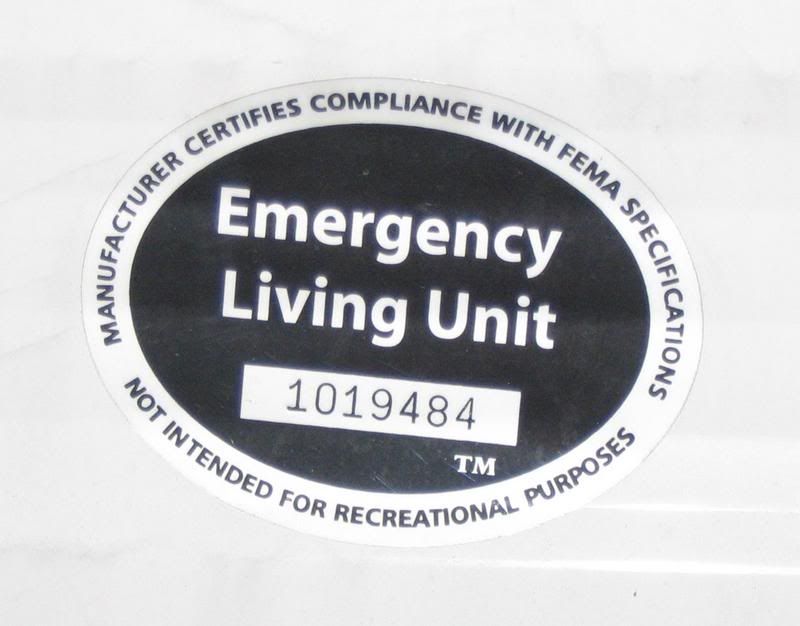
Emergency Living Unit Blog Crue

Back when I started Tin Can Trailer Trash someone wrote that I was the only person in New Orleans blogging from a FEMA Trailer. I didn't know if that was true then and I still don't.

I do know that there are now several other New Orleans Bloggers living in FEMA "Emergency Living Units".

I think we need to Organize.

I propose we establish the Emergency Living Unit Blog Crue
"to unite fraternally all autocampers" 'Emergency Living Unit Residents' and promote "friendliness among campers residents, decent behavior and to secure plenty of clean, wholesome entertainment for those in camp "Emergency Living Units".

The only requirement for membership is to have blogged while residing in a FEMA "Emergency Living Unit".

I know of several potential members and am looking for more. I hope the Blogosphere will do its thing and help me unite all Survivors in ELUBC.

NOLA Bloggers

Tin Can Trailer Trash
Tim's Nameless Blog
Michael Homan
Kalypso The Odyssey
PH Fred at Humid City
Gentilly Girl
Gulf Sails

Other candidates I found on the Internet.

Confessions of a Wannabe Princess
Jason Sampler
Mary-Pat
Ruminations
Paula's Pad
darnola
Kitchen Politics
Pat
Cameron
Aly
BigMac
Cool Will Gee
Rachel
Kevin Gallagher
aimee
David and Beth
Wendy Michele
tdoe

I actually may have found several more potential members, but I couldn't be sure they had actually blogged while living in a FEMA "Emergency Living Unit".

We need to recruit someone to devise "an initiation ceremony that teaches the prospective member the secret handshake, sign, and password. After singing the official song (which still needs to be written) the trailerite will become an official member of the Emergency Living Unit Blog Crue". We are looking for someone to volunteer to develop an official logo and blog banner so that members of ELUBC can identify themselves.

Maybe in a year or two we can organize Bonus March on Washington, just like the old days.

We could use a better name.

Saturday, December 09, 2006

Darkness Continues but Some Progress Is Made.

Darkness at The Trailer continues unabated. We are still without electricity in our Emergency Living Unit.

I'm staying in the Kenner Kondo, but I go back to The Trailer and the house every few days.

Yesterday I made a visit. Work on the house next door is progressing nicely. More good news. down the block construction has started on one of the cleared lots. They haven't done much but they have started. Further down the block another house has its yard all torn up, with big piles of sand in the yard. They seem to be getting ready to complete the work.

Entergy has now been out three times. They identified the problem, the conductors from the manhole to the meter are shorted out. Entergy sort of knows where the short is, it's under our house or our driveway. Entergy thinks it's because the conductors were submerged for however long they were under water or bexause of f;ppd related settlement. Entergy also says its our responsibility to provide a 2 1/2" conduit from their manhole to our meter cabinet. That was a month ago.

We also called FEMA. They said they would send someone out to put up a pole and a meter. The said they would call us back. That was three or four weeks ago. Someone dug a hole next to the manhole and drove a very stout red metal spike in the ground. That was a couple of weeks ago. No call yet.

Not much progress on my part but the neighborhood is starting to show signs of recovery.

Friday, October 27, 2006

The Night the Lights Went Out

I've been in Atlanta for a few days. On Thursday night we went back to the Trailer. When we got there is was dark, not just the sun going down but the trailer lights and the carport automatic lights did not come on.

Not Good. But not that bad. I've had similar problems before with the trailer blowing a breaker or Entergy losing power, although I thought since summer was over that particular problem would subside.

I checked that panel in the trailer the main breaker was tripped. I reset the breaker and still no power.

I checked the panel in the house and all of the breakers were fine. There must be an Entergy outage in the area. I went out and checked around the neighborhood.

I was wrong. The power was out but only in my house. There were circuit breakers blown in the trailer but not in the house.

She called Entergy and they told us they would send someone right out, sometime between 7:30 and 10:40. Yes that accurate 10:40. I have no idea how they arrived a that particular time span.

We decided to go store the groceries we had just bought. Entergy said we didn't need to be there. At about 7:15 She got an automated call on her cell phone saying that the problem had been corrected. We turned around a headed back to the Trailer.

When we got there still no power. I checked and Entergy had indeed been there. They removed the seal from the meter but had not done anything else. We called Entergy again. Again they said they would send someone out before 10:40. I decided to stay and if necessary spend the night as we could not be sure what Entergy would need when they came back out.

She decided to wait for a while and see what happened. About 15 minutes later another Entergy guy showed up in a bucket truck. That seemed a little odd as our electric service is underground.

It took him about 15 minutes to determine that all of the wires from the manhole in the sidewalk to the house were dead. He tried several ways to get the service back up but it was useless. He offered to have another larger crew come out and see if they could replace the wire or rig a temporary supply that night, but he said he it would be late, very late and he wasn't sure they could really do anything anyway. He suggested we go stay somewhere else, if we could.

She could go to her mothers I was considering staying in the trailer anyway, it was cool and I didn't need electricity to sleep. Eventually I realized that I did need electricity for hot water so I went with her.

The next morning I dropped her off at work and headed to the house. Entergy was there setting up when I got there. Two guys gave me a run down on what they were going to do and the possible things they could do to get us back up. They also said they might not be able to fix it.

I went about some chores I had to do and let them work. In a little while they came and told me it was no good. There was a short in the underground cable either under the house or under the driveway. I would need to get an electrician to replace the service.

They gave me their numbers and told me since I was living they they would put me at the top of the list as soon as I was ready and they would come and hook me up.

Great. I am now trailerless.

Tuesday, October 10, 2006

Head'em up, Move'em out

I've written before that my neighbor has been trying to get rid of his unused FEMA trailer for months. It's gone. It disappeared over the weekend. I hope FEMA came and got it and it wasn't stolen.

The odd thing is I didn't notice it was gone immediately. I noticed on the way out Sunday but I didn't notice it on the way in or out Saturday, any of several times. It couldn't have disappeared while we slept. You'd think I would have noticed something that big missing.

This is doubly odd because on the way home Saturday afternoon I saw a crew moving a trailer out down the street.

That's at least two less trailers in the neighborhood.

Monday, October 02, 2006

Cold and Damp

With the recent cooler weather, I recall last fall and winter when I first started living in a trailer.

We were in the midst of a severe drought, unless you were living in a trailer.

Travel trailers are designed to be sealed up for storage an travel. They are also designed to minimize the enclosed volume. This means moisture does not escape from a trailer and there is a limited ability for the trailer to absorb additional moisture. Left closed up even in moderate to cool outside temperatures moisture accumulates in a trailer much more than in a house.


Moisture is generated from cooking both by water vapor from the food and water vapor formed by the combustion of propane. Moisture is obviously introduced by washing and bathing. Just sitting around people give off moisture in their breath. I could tell the difference in the interior environment when She was there. The moisture released by two people results in an entirely different feel.

In a house this does not matter because the amount of moisture is a relatively small compared to the volume of the house. In an old house in New Orleans you can barely keep the heat in. You can often feel the wind blowing through the house. At least I could in the camel back we lived in uptown.

The only solution is to actively operate the trailer in response to the weather and use. You can run the air conditioning all the time to keep the interior dehumidified. That's pretty much what we did all summer. Last fall I opened the trailer doors, windows and hatches up to allow the moisture to escape. It worked pretty well as long as temperatures were moderate and humidity was low. It doesn't work well when temperature are low or humidity is high.

Thursday, September 21, 2006

How I Became Trailer Trash - Part 3:

Hooking Up

Our trailer was left sitting in our neighbors driveway, there was no place to put it on our lot. The entire front yard was full of debris from the ongoing gutting. No one had been by to haul the debris. The Trailer was too tall for our driveway.

No FEMA krewe would come by to hook up up. Our Trailer was a "Drag and Drop". We were on our own.
We had no idea how to hook up a trailer, never having been in one until recently. We quickly discovered we needed a thirty amp electrical outlet, a water hose and a sewer connection to be able to use the trailer. We also needed place it, level it, and anchor it to the ground.

We wanted it in the back yard, we thought it would be more private and secure, besides it wasn't full of stinky debris. It turns out that we couldn't put a truck on the hitch and push it into the yard. Since the guys were still gutting the house, we got them to simply roll the trailer into position. I think we'll have to get it out the same way we got it in.

Since this was early November I hadn't seen a lot of trailers, FEMA was just beginning to deliver them. The FEMA install we are all now familiar with was not very common. FEMA had only delivered a few trailers and they were mostly going to critical people. I went to the Marietta Georgia RV dealer we had visited to check out trailers and bought a couple of adapter fittings for the sewer connection.

On one of my early flights back in to town I happened to sit next to a guy from North Carolina who was installing FEMA trailers. He was returning from a visit to his family. He explained how they installed trailers. He offered to install the trailer for me. I got his number and had my guys call him .

My Contractor found another guy who said he could install the trailer. He was a trip. He showed up in a Lincoln, wearing the gold chain and looking like he stepped out of the Sopranos. They had no material and spent the better part of the day gathering concrete blocks, wood blocking, plastic pipe and electrical supplies. They also had few tools, fortunately I had most of mine, although some of them were a little rusty.

After two full days the trailer was sort of set up. I had power, water and a sewer connection. I would be able to spend the night in the trailer, using FEMA provided linens and plastic dishes.

I still had to learn how to operate The Trailer.

Tuesday, September 19, 2006

Trailer Stuff

It's kind of interesting. There are many thousands of trailers in New Orleans and no one apparently sees that as a business opportunity.

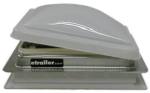
There is stuff that people in trailers need. Most of it is readily available but a some things are special. For example some one stole removed the battery from our trailer. The FEMA Contractor responded fairly quickly. In the process the main 12 volt fuses blew. They are 40A automotive type fuses but they are also higher amperage than most automotive stores carry. The FEMA maintenance guy didn't have any, I went to three auto parts stores to find them.

The little 12 volt "acorn" light bulbs are more difficult to find. These are specific parts necessary for a trailer and only really used in trailers, as far as I can tell.

I've noticed that there are a lot of non-FEMA trailers set up around town. They are easy to spot because they are often old, they aren't white, aren't installed FEMA style or don't fit the profile. These people don't have anyone to call for service. They also need to be anchored to the ground with auger anchors and and metal straps, I had to go to an RV dealer to get the ones I needed.

There is a much larger range of' 'dual use' products, things which are helpful utilizing the limited space available in the trailer.

Thursday, September 14, 2006

How I Became Trailer Trash - Part 2:

The wait.

For a long time we didn't know how our house had fared. Like everyone else we studied the news clips to see if we could find out if our house was damaged or worse flooded. The evidence was ambiguous. We live fairly close the the Lake Ponchartrain Levee. Some pictures showed houses nearby weren't flooded. Because of the location the only access would have been by boat. Other matters seemed more pressing than securing a boat. Finally complete high resolution aerial photos were released. We saw a boat running down our street. We were now officially flooded.

Looking for a Home.

After it became apparent our house was was flooded. We needed to find a place to live. The problem was there was still no power nor any reliable communications. We didn't even know if the Mother in Law in Metairie had escaped flooding. She was in Houston with a house full of relatives. I made a List. The alternatives we came up with;
  1. Mother in Law's.
  2. Mother in Law's Back Room.
  3. A Relatives House.
  4. Rent a Place (hopefully from a friend).
  5. Get our own Trailer.
  6. Get FEMA Trailer.

Investigating and Deciding.

I should explain the Back Room. It is an enclosed carport/party room built by Her Father which had fallen into disuse. It has space and privacy. We had no idea whether it was damaged or not. The same was true of everyone else's house. It turns out the Mother in Law's was not damaged but all of the other relatives either had wind damage or some flooding. Renting a place seemed like an alternate but most of the people we knew of who had rental property had tenants, or had damage. One friend offered to rent her weekend condo in the Warehouse District, but then she decided to sell it. None of these alternatives were certain.

We decided to look at Trailers. We took a trip to the Three Way Campers in Marietta Georgia. The people there were nice and simply let us wander around the lot looking at trailers. Of course I'd done the obligatory Internet Investigation. I had a dangerously limited knowledge of Trailers. I knew the difference between a Fifth Wheel, a Travel Trailer and a Motor Home. Mostly I wanted to see if She thought we could live in one. If so how big did it need to be? I figured because of Catch-22 we could not qualify for a FEMA Trailer.

A Contractor friend changed everything. He told us how to get FEMA trailer real quick, without dealing directly with FEMA.

How we got our Trailer

We got our trailer through the Early Return Program of the State Department of Economic Development, The Governor considered us essential to the recovery. In reality I think anyone who asked would have been considered essential. The Catch (some lower number than 22) was the we had to set up and hook up the trailer ourselves, at our cost. That turned out to be relatively easy to do. We got our Contractor friend to do (it for a small fee).

She undertook getting a trailer as a crusade. She got the forms. There are always forms. She faxed them to a woman at the State who tracked our trailer application and delivery for us. We found out about the program in early October and by the end of the month She was calling every day (sometimes twice) to see where Our Trailer was. It was their own fault. They told Her how quickly they could do things. She held them to it.

We finally got The Call. Our trailer was to be delivered the First of November. Late in the evening, after dark, in a depopulated part of New Orleans. Neither of us were in New Orleans so we asked someone from our office to meet the trailer. It was her first day on the job. The FEMA contractor (Flour) called it a “drag and drop”. They couldn't even drop it in our yard. It had a 6ft high pile of all the stuff we used to have. The trailer was also too tall to fit down our driveway. They had to drop it on my neighbor's driveway.

First Sight.

I returned to New Orleans the day after the trailer was dropped.

I had never visited the house after dark before. I also needed to go pick up the trailer keys. They were left in the furnace compartment of the trailer. Besides I couldn't wait to see the trailer. I also wanted to see what the city looked like after dark. I grabbed my flash light and headed out. Things were not looking good. I drove out from downtown. As I drove through Lakeview and Gentilly it is was dark. There were no lights at all except for an occasion puddle of an occasional street light or a random generator.

Of course the major problem we thought we would have was electricity. Without it we couldn't occupy the trailer. We were investigating generators and getting temporary power from Entergy. Neither looked like good options, although the generator could work. I was thinking about this on the way out to the house.

I was also thinking "I am not lucky". She is. One of the reasons I married Her was to partially counter my own abysmal fortune. I was born under a bad sign. If it wasn't for bad luck. I wouldn't have no luck at all.

As I approached our neighborhood I began to notice a glow in the dark. I arrived at our street. I was elated to see most of the street lights were on. She had worked her magic. There was power on our street. The possibility of power to the trailer had improved considerably.

I drove into our driveway and retrieved the keys. I did a quick check of the trailer. It was pretty much as I had expected. I did a quick inspection and decided to head back, there was still a curfew. First for some reason, I decided to look at electric panel in the house. It had a red tag on it. Another miracle, our electric meter had not been removed. I had a legal connection to power. She is a Goddess.

We determined later in the daylight that, unlike our neighbors who had all had their meters disconnected, our electric meter and panel had been located high enough that even though the house flooded the water never reached the panel.

All we had to do now was hook the trailer up and move in.

Friday, September 08, 2006

FEMA needs new clothes.

It has recently occurred to me that FEMA needs a sense of dedication, a feeling of a special mission. They also need clearer lines of communication and responsibility.

I have a suggestion.

Abolish FEMA and create the FDRS (Federal Disaster Response Service) as the country's eighth Uniformed Service, along the lines of the PHS and the Coast Guard. Using military style organization and headed by a professionally qualified Director General, similar to the Surgeon General (or the Commandant of the Coast Guard).

I have read that some find the PHS redundant and unnecessary, that may be. The addition of military rank, discipline and uniforms will, I think, help FDRS interface with the mostly similarly uniformed and organized First Responders and military support essential in the early stages of any major disaster response.

As a Uniformed Service the FDRS could fall under the administrative umbrella of the DHS during normal times but in upon declaration of a disaster the Director General should report directly to the President, much like the military, or the Coast Guard (which in times of war comes under command of the Navy). Next time they might be able to be as effective as the Coast Guard was mobilizing and delivering help.

Wednesday, September 06, 2006

Electrailer: Basic Cable

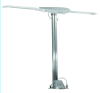
Our trailer was wired for electricity, and it seems perfectly adequate. It was also wired for a telephone, an amplified TV output and a CATV connection. There is an interesting TV antenna which elevates and trains with a mechanical locking crank and dial arrangement. The "entertainment center" consists of a built in "boom box" ( AM/FM/CD/Clock/Alarm) with an exterior radio antenna, and a pair of car speakers mounted under the cabinets.

When I first occupied the trailer around the beginning of December, it was not clear what connections to the world there were. I determined that the first step I needed to take was to get a TV, if only to fill the hole where a TV was supposed to go and make sure I wasn't missing anything. In December, shortly after connecting power to the trailer I visited Walmart in Kenner late one evening and purchased MY FIRST GREAT BARGAIN. I got a 21" flat screen TV with a built in DVD player for $112. It has a great picture.

I also discovered that only a few of the broadcast TV stations were back on the air. After several calls to Cox, all I could get was a suggestion to try to hook it up and see if it works. After a Saturday tramping around in the weeds, salvaging cable from the house and installing a makeshift connection I was amazed that I could get Basic Cable. I had information coming in again. Some of the off the air stations were actually sending a signal over the cable TV system.

Around the middle of December I was able to move in pretty much full time. I started to look into a better way to connect to the Internet. At this point I had no phones at the office nor did really we have an office. I was using the Internet at my mother-in-laws house in to get email, but had no files nor anyplace to keep anything.
When I called Bellsouth and was stunned when told they could install my phone by the end of the week and provide me with high speed Internet. I signed up immediately, although I was skeptical. A few days later I saw a telephone guy in my yard, he replaced the Network Interface and told me he was doing every house in the neighborhood. Things were looking up.

I was eagerly anticipating a reliable connection to the world. Of course I had my cell phone but it had never worked really well in our area even before the flood. The installation day (a Saturday) came, by this time I had rigged an extension from the trailer to the Network Interface. The day passed without Bellsouth or a dial tone. I called and was informed that they were "waiting on facilities" and they couldn't tell me when my service would be restored.


By now, late December I had phones and an Internet connection at the office, even if we didn't have much furniture. I could at least communicate. I called "my friend in the digital age" and asked if I could get high speed Internet. They weren't sure, their suggestion again was to try it and see if it worked. They offered to replace my flooded equipment. I went down to the Cox headquarters and picked up a new cable modem. Son of a gun it worked, most of the time at least.

Friday, September 01, 2006

Fixing the Trailer II.

Last week I returned home to find a "Monthly PM Checklist" stuck in my door. Thats the first one of these I've seen. I guess they finally found me. As usual there was no information on the checklist to identify the company that made the inspection nor any emergency contact number.

My new problem is the roof leaks. Every time we have a hard rain we had a few drops of water coming out of a light fixture. Nothing dramatic, just a few drops, but I was concerned that the light might short out or the leak might get worse.

I decided to call maintenance. I had gotten the number before but lost the note.

I looked on the FEMA website to see if there was a directory for such things. No such luck. I called the FEMA toll free number 1-800-621-FEMA (3362) to ask for the trailer service number for New Orleans. That lead to a 20 minute phone question and answer session primarily designed to fill out a form on the screen so that my call could be tracked in their system. Why do they need all of that information to answer provide a single phone number which should be public anyway?

Even though I prefaced my with a statement that I was living in a FEMA trailer and needed service. The operator did not immediately offer to give me the FEMA trailer hot line 1-888-294-2822 or ask my zip code which would have identified the correct maintenance contractor as Smith Research Corporation.

Interestingly the Smith Research Corporation website does not have any phone numbers on it. nor can I find any web resource which would allow me or anyone else in Louisiana or New Orleans to figure out the correct number. I did find such a site for Mississippi. You'd think someone would have thought to communicate these things in a way that is easy to find.

Fortunately I had stored it in our office electronic address book. Once I thought to check there I was able to find it and call them at 1-866-476-7329. The sent someone out that afternoon.

The two guys were appropriately concerned and took out the light fixture. They said it was to get a new part, and to show the supervisor the problem. I was told they would call back Monday or Tuesday. No call back.

It rained again a few days later. This time there was a lot more water and it came in through the TV antenna. The TV antenna is a complicated rig. It is on a mast which is raised an lowered by a hand crank and aimed by a locking rotating ring arrangement. It works pretty well, I used it for a while before I got cable TV. It leaked so much the floor was wet and it filled a pair of her shoes, that were unfortunately left right under the crank. I called again. Again they sent two people the same night, arriving at 1:20 AM. Of course they couldn't do anything in the dark. The guys promised to come back at 3:00 PM the next day.


The next day I took off early work so I could be there. They told me some one must be there for them to work on the trailer. I think it's so you can sign the work order for them to get paid. Unfortunately they never came back. The next morning I called again. This time they called back. I was told they would send someone out after five. I left work early to meet them. One guy came out, looked at the situation and caulked some stuff. It seems to work so far.

I'm still waiting for them to replace the light fixture. I made one appointment and they didn't show up. I guess I'll call about that next week. I'm sure it will be the third installment in this saga.

Wednesday, August 30, 2006

Evacuating FEMA Trailers

With Ernesto out in the Gulf, I began to reconsider my evacuation plan. Our plan had always been to retreat to Atlanta and return as soon as possible it always worked well, except for last time, well you know what happened.

Since we are now living in a FEMA Travel Trailer I have my few remaining clothes in the trailer and my relatively few other possessions stored. I think I might clean out the trailer as much as possible and put at least my clothes in the trunk of the car.

FEMA as usual has come up with a completely dada series of rules regarding the placing and removal of trailers.

We have all heard that FEMA bought several thousands of House Trailers for use in Louisiana, Texas and Mississippi. Many of these trailers are parked in a field in Arkansas, reportedly because FEMA has a rule that says that they can't put House Trailers in a flood plain. The rule is justified because they can't move them out of the way of flood like the more mobile Travel Trailers. I guess they never bothered to look at the NFIP maps which show virtually all of Louisiana south of I-10 is a flood plain.

They did however realize that Katrina was a hurricane and that there could be another hurricane at any time. I guess the four hurricanes that hit Florida in one year was the clue. In order to protect residents of Travel Trailers FEMA decided that Travel Trailers must be connected to the local sewer system, set on blocks, with the wheels off the ground and anchored to the ground with metal straps to improve wind resistance. In order to meet the needs of the disabled many Travel Trailers are fitted with large wooden ramps, every trailer was provided with fancy steps. They are effectively immobile.

In addition to these already severe impediments there are the operational problems of moving more than 100,000 Travel Trailers in advance of a hurricane. Since the paths of hurricanes are so unpredictable there is seldom more that 3 days warning of a storm, just look at the changes in Ernesto's predicted track.

If you assume you have at most 3 days to relocate the 100,000 trailers placed because of Katrina. You need to move 33,000 trailers a day. If you assume you need to drive them 250 miles to safety, one truck and driver could move little more than one a day. If you have two drivers per tow you might double that. If you assume a crew of four could disconnect and prepare 2 trailers per day for travel, you would need 16,000 crews and 64,000 workers.

During the same time, mixed in with the 100,000 Travel Trailers, approximately 1,000,000 people in 400,000 cars would be evacuating. That doesn't include bringing them all back.

Does that make any sense to anyone?

Wouldn't it be much simpler and cheaper to simply waive the "no House Trailer in a flood plain" rule and replace any trailers that might get destroyed?